


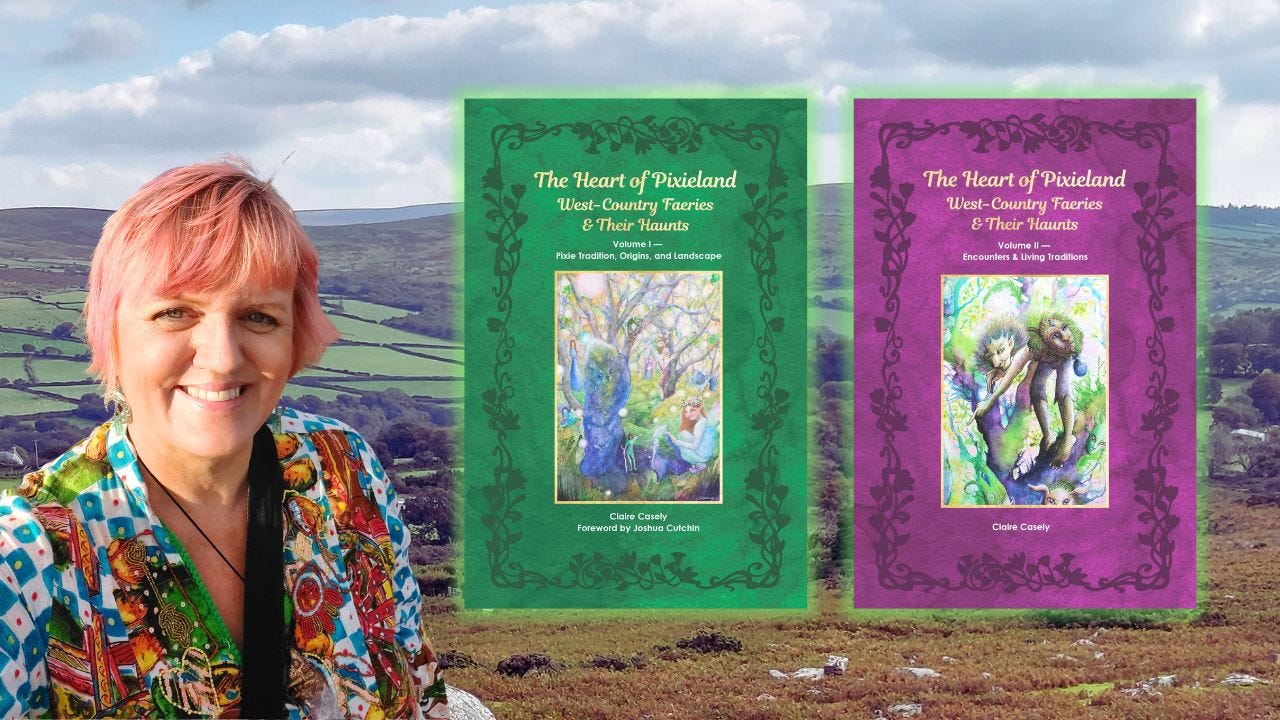
One of the enduring themes of The Heart of Pixieland: West-Country Faeries & Their Haunts Volumes I & II is that stories continue their journey long after they are told. I am moved by some of the heartfelt reader responses towards these books since their publication. These readers have shared their own reflections, memories, and responses to the book, and I am deeply grateful. Reviews are crucial to all authors, especially indie authors like myself.
I’ve gathered some of these reviews here to honour the magical dialogue between storyteller and reader! The reviews are interspersed with some of my photos taken during my research of the books on Dartmoor and elsewhere in the West-Country.
The first review is from Dr Meri C Dickson, PhD in Religious Studies, and fairyologist:
Heart of Pixieland is a wonderful, eclectic mix of knowledge, anecdote and research that brings to life and makes specific a hitherto well-known name, but unexplored subset of fairy beings. Added to that is Claire’s own warm and personal style that invites the reader in for a cosy chat.
I had long believed that “Pixies” was just another name given to fairy folk, and my knowledge did not extend far beyond that they were commonly called so in the West Country and were related to Cornwall. What Claire does through her scholarship, without becoming dry and academic, is raise the profile of this group of fairy beings as a particular fairy type. The pixies have their own traditions, attributes and encounters particular to them, and through this volume, become recognisable as a fairy race in their own right, sharing similarities, it is true, with other regional varieties of fairy beings but retaining their own West Country affiliation and sense of belonging to that part of the country.
Until now, I have known Claire through her podcast where she encourages us to listen closely so that we don’t miss the fairy whispers. This volume uses the same charming and warm voice that imparts deeply and clearly researched knowledge.
When you pick up this volume you will be pixie-led into a vibrant, delightful Pixieland. You will go away with new or renewed understanding of the Pixies, of the land they inhabit, the history and folklore of their specific kind and the warm and devoted voice of the author. And it is that which is truly the heart at the centre of Pixieland.


This next review is from Tamsin Rosewell, Bookseller, illustrator, Trustee and Secretary of The Blake Society:
A wonderful, readable and important addition to all folklore bookshelves!
Claire Casely has given us a hugely readable, but detailed and deeply researched study of the fairy folk of the West Country. There are two volumes here - the first explores the origins and traditions, and the second makes a very valuable collection of encounters and also living traditions.
Like Katharine Briggs and other folklore historians before her, Claire Casely records all those little details of ritual that you need to keep safe crossing the landscape, and the places (still) felt to be the most fairy-haunted, dialect words and descriptions.
Like many areas of these Islands the piskies and their fellow spirits within the hills of the West Country have their own atmosphere and character. Claire’s approach of presenting historical research while also accepting a thriving, developing modern interest and acceptance in the unseen that lives alongside us, feels right for our times too. We’ve seen a huge rise of interest in folkloric traditions, beliefs and practices and these books respect that completely.
I think these two volumes form a great addition to any folklore shelf, and they will also be an important record and collation for future researchers. Highly recommend!


Finally, a review from Mike Fiorito. Mike is an award-winning author of several books including UFO Symphonic, The Inner Space of Outer Space, and For All We Know:
There are books that catalogue the world, and there are books that quietly rearrange it. Claire Casely’s The Heart of Pixieland belongs to the latter category: a work that does not argue for the existence of faeries so much as it alters the conditions under which such a question can even be asked.
Joshua Cutchin’s foreword opens like a door left ajar in an old house. He recalls Tolkien, via a fragment preserved by C.S. Lewis, lamenting the severance between modern people and the land—that we, nourished now by distant soils, have become “synthetic,” unrooted, unable to see what once stood plainly before our ancestors: the dryad in the tree, the nymph in the stream.
Casely’s book enters through that breach.
What unfolds is less a work of folklore than a cartography of attention. Pixies, in her telling, are not merely beings but events: flickers at the corner of vision, echoes in marshland, distortions in time, small rearrangements of the ordinary. They do not present themselves as stable forms; they shimmer, they recede, they change scale. To read Casely, one senses that the problem is not that these entities are elusive, but that perception itself has grown inflexible.
Cutchin recognizes this and situates Casely exactly where she belongs: not as a distant scholar of belief systems, but as someone embedded within a living terrain. The Devon landscape is not background here; it is co-author. Hills, streams, tors, bridges—these are not settings but participants. The pixies are inseparable from place, and place, in turn, becomes inseparable from consciousness.
I felt, reading this, an immediate kinship.
In my own work, whether tracing the symbolic migrations of UFO narratives or the strange harmonics between music and altered states, I have tried to suggest that phenomena do not occur to us so much as through us—at the porous boundary where perception and world meet. Casely operates in precisely that threshold. Her pixies belong as much to the landscape as to the mind, and to insist on choosing one over the other would be to misunderstand both.
There is something quietly radical in this refusal to resolve ambiguity.
Casely gathers accounts—archival, contemporary, personal—and allows them to coexist without forced synthesis. Pixies appear as lights, as small humanoids, as sounds, as moods. They mislead, they nurture, they vanish. They resemble, at times, the occupants of other domains we have given different names: ghosts, extraterrestrials, elemental presences. Cutchin notes this interplay approvingly, describing her as a kind of Fortean guide, attentive to patterns without imprisoning them in theory.
This openness recalls Borges, who understood that the catalog of wonders inevitably becomes a labyrinth, and Calvino, who treated reality as a set of interlocking invisibilities. Casely’s Pixieland is just such a terrain: a network of correspondences rather than a taxonomy.
What emerges, finally, is not belief, but relation.
Casely suggests—quietly, insistently—that the world remains enchanted, but that enchantment requires a recalibration of attention. The old etiquette she records—touch the ground, ask permission, leave an offering—reads less like superstition than like a protocol for entering into reciprocity with place. The landscape, in this sense, is not passive. It responds. It withholds. It invites.
This is where her work converges most clearly with my own concerns.
I have long been interested in how modern consciousness might relearn a form of listening—not to verify the anomalous, but to remain in contact with it. Casely’s book offers, if not an answer, then a practice: an attunement to the subtle, the fleeting, the nearly perceived. The pixies, one begins to suspect, are not vanishing—they are waiting.
At the end of Cutchin’s foreword, one feels that the real subject of The Heart of Pixieland is not the faerie realm at all, but the human capacity for wonder, dimmed but not extinguished.
To read this book is to feel, however briefly, that something has shifted—that the hills might indeed remember us, if only we could remember how to look.
And perhaps that is enough.
— Mike Fiorito
The stories in the Heart of Pixieland belong to the landscapes that inspired them, and they also live in the hearts of the the people who carry them forward. I am thankful to each reader who brings their own memories, questions, and experiences to the page, and it is a joy and a privilege to see those connections being made.
Thank you for sharing this journey into Pixieland with me.
Claire x